5 min read

Insights from the Healthcare Design Conference: Q&A with Circadia

Insights from the Healthcare Design Conference: Q&A with Circadia

Each year, the Healthcare Design Conference brings together leaders, innovators and practitioners shaping the future of healthcare environments. The Circadia team had the opportunity to attend and dive into emerging ideas, technologies and design strategies shaping how care environments are built and experienced — particularly as behavioral health design and adaptable healthcare furniture solutions grow increasingly vital across the industry. 

This year’s Healthcare Design Conference + Expo (HCD 2025), held in Kansas City, marked one of the most expansive and inspiring gatherings to date. With more than 85 keynote and educational sessions, pre-conference workshops, facility tours and an expo hall featuring over 250 exhibitors, the event served as a powerful crossroads of ideas and collaboration, reinforcing how behavioral health design and trauma-informed spaces are becoming foundational elements in conversations about the future of care. 

Keynotes underscored a deeper message: shared identity and collaboration. Leaders encouraged attendees to ask, “Who do we want to be?”, emphasizing that future health-care spaces are not just built by individuals, but by a larger collective committed to innovation, equity, and connection. 

To capture what stood out most, we asked our Circadia Healthcare team who attended this year’s expo a series of questions about what they learned, what surprised them, and what trends they believe will influence the industry next. Their reflections highlight the shifts happening across healthcare design—from behavioral health and modularity to AI, flexibility, and human-centered environments, all supported by thoughtful healthcare furniture solutions and emerging approaches to empathetic design. 

Explore the full Q&A with our team members. 

Q&A 

How did this year's theme resonate with you? How did it deepen or challenge your thinking? 

Gigi Rice: 
This year’s focus on the people using the space, reinforced how much our work goes beyond just filling a space — it’s about creating environments that actually support healing and help people feel cared for. It made me think more about how every product choice — from recliners to trash cans — impacts both comfort and dignity. 

Steve Jobe: 
There were a lot of vendors that comprised all aspects of healthcare including A&D firms, construction, signage, artwork, medical equipment and furniture for all aspects of healthcare. There are a lot of options to consider. The product space is getting very full. 

What was a “stand-out” moment for you at the event and why did it resonate?

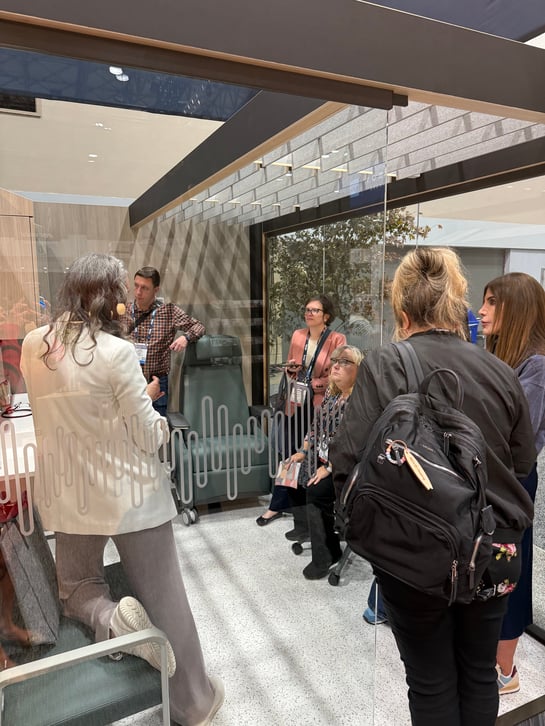
IMG_7861

Gigi Rice: 
A discussion on behavioral health spaces really stuck with me. The vendor talked about “restorative safety,” meaning safety that also feels calming and respectful. It made me think differently about specifying finishes and furniture — not just for durability, but for how they can help people feel secure and at ease. 

Dylan Robben: 
There were two sessions that stood out to me. The first one was the first mental hospital built in Kansas in I believe 40 years. It was interesting to see how the design brought elements from the past and elements of the present together. For example, using the snowflake layout of the facility which dates back to early facilities. The other session was NICU design. Something that really stood out was the trend of having open bays versus private rooms going back and forth throughout the century. 

Annie Adrian: 
The focus on behavioral health furniture and applications stood out to me. The fact that the top award of the expo, The Innovation Award, was rewarded to a strictly behavioral health vendor’s product spoke to that. 

Steve Jobe: 
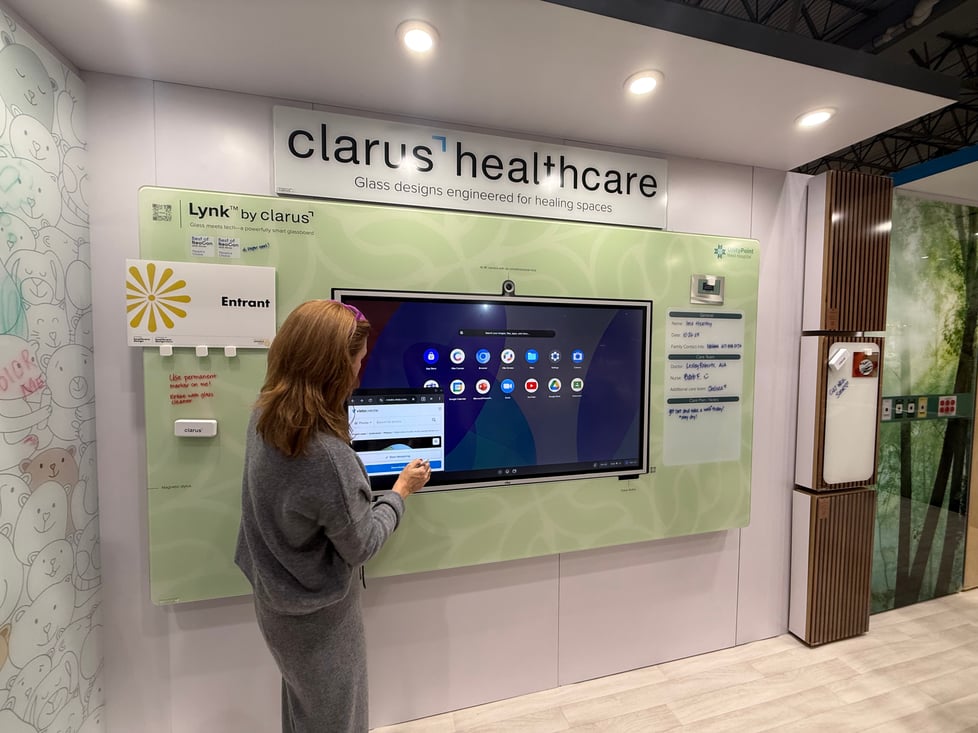
The manufacturer, Krug, introduced a patient recliner that actually electronically takes a patient’s vital signs as they sit in it and projects the vitals onto a monitor. I am wondering how accurate the information will be, but the concept is very unique and timesaving for caregivers if it works. 

What emerging trend or idea from the event do you believe will have the biggest impact in the next year, and what do you expect to change because of it? 

Gigi Rice: 
Flexibility is definitely the trend to watch. So many facilities are designing spaces that can easily shift — for new technology, different patient populations, patient flow, or just to stay adaptable. I see that driving more interest in modular furniture systems and multipurpose layouts that can evolve over time. 

Dylan Robben: 
I would say the use of sensors and AI were more present this year. I know Krug had a device option in their seatings that would detect if a person were to get out of their chair. With staffing shortages in healthcare, this device would be a great aid in keeping track of patients. 

Annie Adrian: 
The push to a more modular healthcare system. Vendors like Studio Craft, partnered with Steelcase, are revolutionizing modularity, and I believe that is where hospitals are starting to head. 

Steve Jobe: 
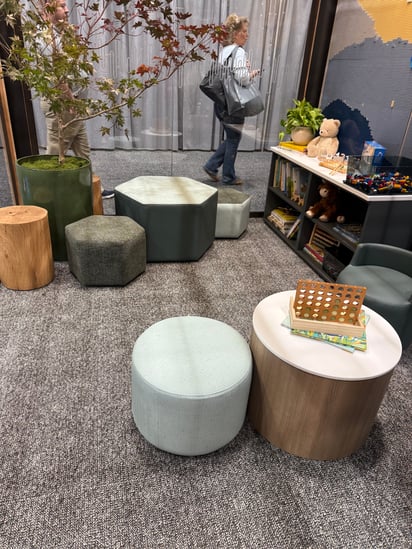
There is more and more consideration of Behavioral Health furniture. The major lines of BH furniture, Norix, Moduform, Cortech, Pineapple and a few others have added to their lines, but other healthcare manufacturers are seeing that need to add these offerings to their portfolios. The focus is on humanizing the products and making them appear warmer and more inviting than the institutional look much of it has had for years. This needs to be done while maintaining the strict guidelines involved for this type of furniture. 

IMG_7841

What surprised you? Or was there an assumption about your work/industry that has shifted thanks to something you learned at the conference? 

Gigi Rice: 
I was surprised by how much focus there was on the staff experience. The idea that caregiver well-being is directly tied to patient outcomes came through loud and clear; staff respite areas are overlooked. It reminded me that when we plan spaces or product selections, supporting the people who do the caring is just as important as supporting those receiving care. 

Annie Adrian: 
It always surprises me what clients like and take interest in. Sometimes, it’s something you never expected them to look toward. It just goes to show how important it is for us, as reps, to keep exposing our clients to new products and applications. You truly never know what they may need or gravitate toward. 

IMG_7860

If you were advising someone who couldn’t attend the event — what is one thing you would tell them to watch for or adopt in their work, and why? 

Gigi Rice: 
I’d tell them to go in with an open mind — it’s a big conference, and the real value is in seeing what’s new and unexpected. Don’t just hunt for the two or three things you already know you need; walk the floor, sit in on random sessions, and look for ideas that spark new thinking. Some of the best solutions come from areas you didn’t even realize had answers to your challenges yet. 

Dylan Robben: 
I would say AI. I think it was very present at this year’s conference, mostly in conversations. I would tell someone to figure out how to become buddies with AI. I believe many people are scared of it taking their jobs and because of that, stay completely away from it. I know I have fallen victim to that, but after the conference I have decided to start treating it as a buddy. 

Annie Adrian: 
Continue to show applications including modularity, behavioral health elements, and residential-looking healthcare settings. Those are elements all of my hospitals are interested in right now. 

Steve Jobe: 
Make sure you research vendors. There are so many options to choose from. Pay attention to lead times for products, where they are sourced, distribution, customer service and what contracts they are a part of. 

Looking Forward 

As the healthcare landscape evolves, conferences like HCD offer a valuable look into what’s shaping the environments where care happens. From modularity and behavioral health to human-centered design, technology, and the growing emphasis on staff well-being, the themes our team observed point toward a more flexible, empathetic, and future-ready approach to healthcare spaces. 

Circadia is excited to bring these insights back to our clients and partners, and to continue exploring how thoughtful design and smarter healthcare furniture solutions can meaningfully support both caregivers and patients in the years ahead.  

Want to dig even deeper into how design choices impact care environments? Check out our related insight: Selecting Proper Furniture and Finishes for Healthcare Spaces. 

And if you’re planning upcoming projects or evaluating new product solutions, connect with us—we’d love to bring these learnings to your next healthcare space. 

Case Study: First Bank’s New Home

Case Study: First Bank’s New Home

First Bank is a family-owned financial institution with deep roots in St. Louis and a vision for the future. When it came time to build a new...

Read More
Case Study: A New Era for Learning in Marshall, Missouri

Case Study: A New Era for Learning in Marshall, Missouri

Historic School Becomes a Future-Ready Campus for 3rd 4th and 5th Grade Success After more than 50 years without a new school building, the...

Read More
Case Study: Bishop Ward High School’s Library Design Upgrade with Circadia Furniture Enhances Learning Environment

Case Study: Bishop Ward High School’s Library Design Upgrade with Circadia Furniture Enhances Learning Environment

ABOUT: Bishop Ward High School Library Design Established in 1908, Bishop Ward High School in Kansas City stands as a longstanding private Catholic...

Read More